
Bernards Township City Directory Collections
Documented city directory evidence for Bernards Township is a set of nearby regional publications, not a proven, complete township run. The useful volumes reach Basking Ridge or Bernardsville through broader Morristown and Somerville-area coverage. That distinction matters. A name found in one volume is a useful historical address and occupation lead; a missing name may mean the book did not cover that community, street, or type of household. Library files and newspapers are part of the core trail, not an afterthought.
| Collection | Years | Where Held | Access |
|---|---|---|---|
| Polk's Morristown directory, including Bernardsville and Basking Ridge | 1930 | Morristown and Morris Township Library, reel 6 and book NJ917.49/Mor/1930 | In-library microfilm or book; regional coverage |
| Polk's Morristown directory, including Bernardsville | 1938 | Morristown and Morris Township Library, reel 7 | In-library; check each address for inclusion |
| Richmond's Somerville/Bound Brook Directory | 1928-29 | New Jersey State Library directory inventory | Regional cross-check, not a complete township run |
| Polk's Somerville/Bound Brook directories | 1930-31 and 1936 | New Jersey State Library | Printed regional source; confirm municipality and address |
| Somerville-area directory editions | 1970, 1971, 1973, 1975, 1976, 1979, 1980 | New Jersey State Library and regional libraries | Check volume by volume for Bernards coverage |
| Bernardsville News archive | 1897 and 1903-2017 description; digital issues through 2024 | Bernards Township Library and Digifind-It | Name, street, notice, and date research |
The Morristown directory inventory and the New Jersey State Library inventory establish the years above. They do not establish a dedicated Bernards Township series, a final printed year, or a local reverse-directory shelf. Treat regional books as evidence to inspect, never as a full resident roll.
Polk City Directory Volumes Near Bernards Township
The 1930 Polk volume is the clearest early city-directory starting point because its catalog title expressly includes Bernardsville and Basking Ridge. Morristown Library holds it on microfilm reel 6 and as NJ917.49/Mor/1930. The catalog also identifies a 1938 Polk Morristown directory that includes Bernardsville and Morris Plains on reel 7. Copy the book title, reel number, page, spelling, and nearby street names when a household is found. Those details make a later request to a librarian or archive much easier to reproduce.
Neither title proves that every Bernards Township address appears. Postal names, township boundaries, and the publisher's chosen coverage can differ. A negative result is therefore only a reason to check the next source, especially a newspaper, vertical file, or deed. The 1930 and 1938 volumes are separated by eight years, which makes them valuable paired snapshots but not an annual account of who lived at an address.
- 1928-29: Richmond's Somerville/Bound Brook Directory provides an early regional comparison point.
- 1930: Polk's Morristown volume includes Bernardsville and Basking Ridge, while a Polk Somerville/Bound Brook edition is also cataloged.
- 1930-31: Polk's Somerville/Bound Brook sequence offers a second regional shelf route.
- 1936: A Polk Somerville/Bound Brook directory is listed in the State Library inventory.
- 1938: Polk's Morristown directory includes Bernardsville on Morristown reel 7.
- 1970-1980: Selected Somerville-area editions are cataloged for 1970, 1971, 1973, 1975, 1976, 1979, and 1980.
Note: Record a directory's stated geographic coverage before treating a missing household as evidence that the person had moved away.
Regional City Directories for Bernards Township
Somerville and Bound Brook volumes offer a second regional route. Richmond's 1928-29 directory, Polk editions for 1930-31 and 1936, and cataloged Somerville-area editions from 1970 through 1980 can provide neighboring-community context. They are especially useful when a family used a county-seat business address, appeared in a nearby notice, or moved between communities served by the same regional market. Check the municipality printed in the book and the street address beside the name.
These books should not be used to infer a continuous directory record for Bernards Township. A household can be absent because it lived outside the compiler's territory, was not listed, or appeared under a different spelling. For an old address, pair the regional directory with the contemporaneous newspaper and a dated recorded instrument. The combination is much more dependable than one undated name match.
Bernards Township City Directory Leads
The Bernards Township Library Local History collection provides the practical fallback when a printed directory does not name a household. Its local-history resources include a searchable catalog, vertical files, Nettie Allen material, and the Bernardsville News archive. The files contain clippings, photographs, business and house histories, organizational records, and references to local people. Ask the reference desk for the surname file, the street or house file, and a newspaper date rather than asking for a single all-purpose directory.
The library's Digifind-It digital archive brings together documents, newspapers, videos, and digitized Nettie Allen material. Its collection description reaches digital Bernardsville News issues through 2024. The archive is a good place to search a surname alongside a street name, then return to the local-history desk for unpublished clippings or photographs.
The Bernards Township Library digital archive shows the online collection that complements shelf research.
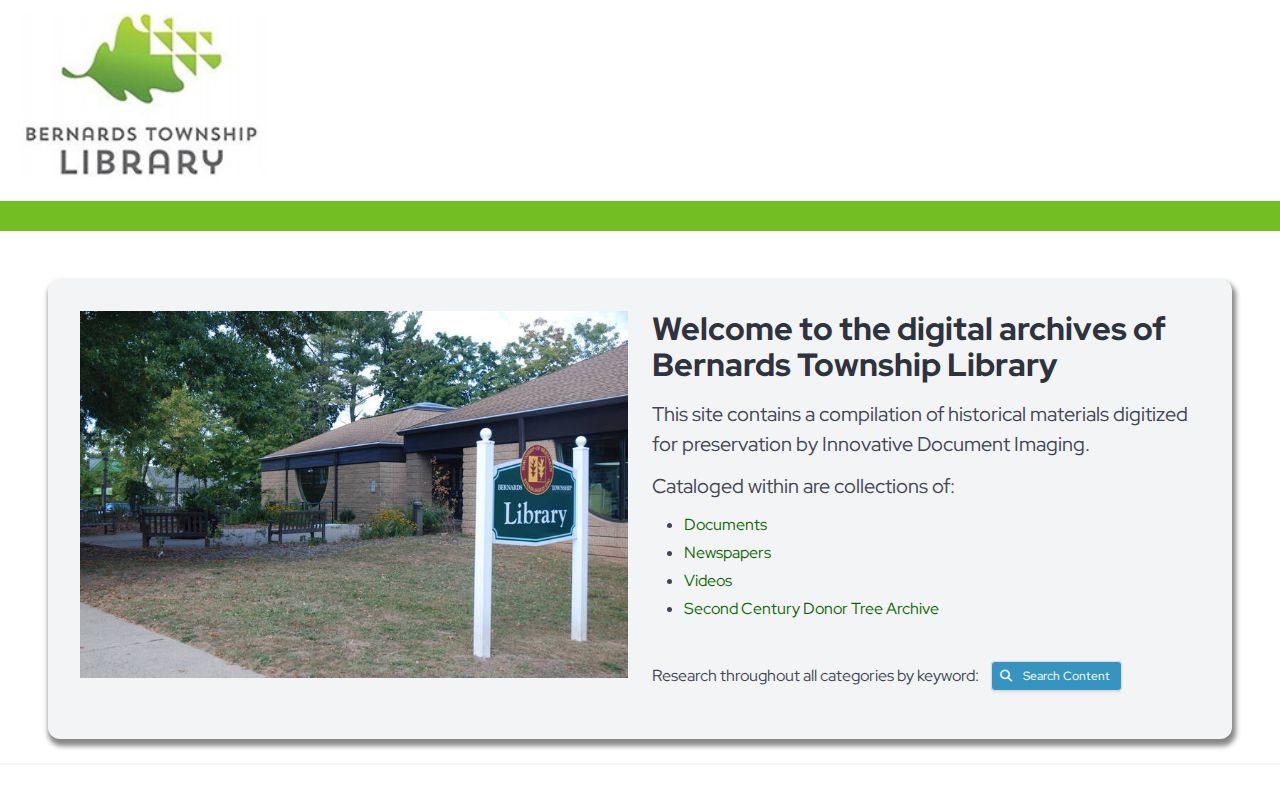
The image is a reminder that digitized material is one channel in a broader local-history collection, where vertical files and reference assistance may supply the missing link between printed volumes.
Reading a Bernards Township City Directory Entry
A local Polk page was not safely available for direct transcription, so the entry grammar below comes from an inspected 1930 public-library regional directory scan. It is a format guide, not a reconstructed Bernards Township entry. These listings commonly compress several facts into one line. Read each mark in the context of the volume's own abbreviation key, and keep a photograph or note of that key with the entry.
| Name | Surname and given name; a spouse can appear in parentheses when the book supplies it. |
|---|---|
| Occupation | A role, sometimes followed by a parenthetical affiliation in the printed line. |
| Address | Street and number, generally marked h for home in the inspected regional format. |
| Residence mark | r can identify a rooming or renter address in that regional format; confirm the book's own key. |
| Layout | Business and home information can be separated by typography and abbreviations. |
- Criss-cross directory
- A directory arranged by street and number instead of by name. No documented local Bernards Township shelf run was located, so do not assume a volume contains one.
- Householder index
- A name list centered on household heads when a volume labels or provides that form of index; it differs from an address-order listing.
- Abbreviation key
- The publisher's explanation of shortened marks and terms, usually printed in the volume. It is needed before assigning meaning to a letter such as h or r.
Address and occupation statements are dated directory claims. They do not prove current residence, ownership, or a relationship beyond what the line itself says.
Note: Preserve the volume title and page with any copied entry so another researcher can interpret the abbreviation key.
Nettie Allen's Bernards Township Surname Cards
Nettie Allen's collection contains roughly 2,800 handwritten cards arranged by surname. The cards trace founding families and historical details, making them useful when a printed entry supplies only an initial, a street, or a surname with an uncertain spelling. Search the card name as printed, then try known spelling variants found in a directory or newspaper. Handwritten material needs careful reading, so preserve the card citation and avoid treating an inference as a documented relationship.
The library file inventory also points to local people sources that are not printed directories: election papers, farm files, maps, population material, fire and police history, and Township Hall or Health Department folders. The dates in the inventory range across different subjects, from maps beginning in 1766 to farms files noted through 2024. Each folder is a targeted research request, not a published list of everyone who lived in Bernards Township.
Bernards Township's 1930 Election Register
The local-history file inventory names a 1930 General Election Registration List, plus election clippings and results from 1930 to 2004. That register is a notable township-level lead because a modern voter-status tool is not an open public directory. It can help place a historical name in a civic record at roughly the same period as the 1930 Polk volume. Ask the library staff about access, copying, and any privacy limits before relying on the list.
Use the register as a dated corroborating clue. Compare the name spelling and district context with a directory line, a newspaper item, or a census record. A person may be absent because of eligibility, registration timing, or the record's own scope. The folder proves the historical item exists; it does not make every individual detail available online.
Note: A historical election register can support a time-and-place question, but it does not reveal how any voter cast a ballot.
Tracing Bernards Township City Directories
Build a household trail from dated observations. Start with the earliest known surname or address, record the directory's exact wording, and test it against the next available volume. Census schedules show household composition at the census date, while a directory offers an address and occupation snapshot at another point in time. A newspaper can connect the two with a move, marriage, death, property notice, or civic event. A later deed gives a transfer date, not proof that every listed owner lived on the parcel.
- Find the known surname or street in the 1930 Polk volume and preserve its spelling, spouse notation, address, and abbreviations.
- Check the 1938 Polk volume for the same name, street number, or an altered household pattern.
- Pair each directory date with a federal census year and a dated Bernardsville News search.
- Ask for vertical files, local house photographs, and marriage, engagement, or death cards when the printed trail breaks.
- Use the county deed chain, permit history, obituary, or probate material to test a later transfer or disappearance.
A departure from a directory can reflect a move, death, omission, changed spelling, or a change in the directory's coverage. It should never be treated as one of those explanations without another record. When the question changes from historical household context to verifying a present-day record, use the focused Bernards Township resident lookup workflow rather than extending an old directory line beyond its date.
English Farm in Bernards Township Records
The library's farms files include an ownership and genealogy chart for English Farm that documents several connected local family lines. Official township material describes English Farm as founded in 1740 and connects it with the 1781 Washington and Rochambeau march through Liberty Corner. That history offers a place-to-family research route: search the farm name in the newspaper archive and vertical files, then compare names with deeds, probate material, church sources, and regional volumes.
For broader archival work, the Somerset County Historical Society's Van Horne Library holds bound volumes, family files, manuscripts, photographs, maps, microfilm, and early land records. The society offers staff research for a stated fee and turnaround, while the Somerset Hills Historical Society identifies local church, cemetery, map, newspaper, and family-history holdings. These collections help test a directory lead without inventing a continuous resident list.